

The release nobody will launch, and everybody will install
Node.js 26 did not arrive with a keynote moment. There was no feature in it built to trend, no demo that needed a stage. And yet, sometime in the next few months, most production Node teams will end up running it anyway, because that is how Node releases actually enter real systems. Not as a launch event. As an LTS upgrade, approved in a quiet pull request, merged on an ordinary Tuesday.
That is exactly why this release deserves a closer read than it got. The changes that will shape your day to day work in Node 26 are not the ones with headlines. They are the ones that remove a dependency here, retire a workaround there, and, in a couple of places, quietly break code that has been running untouched for years. One of them finally fixes the date handling every JavaScript developer has complained about for as long as JavaScript has existed. It just did it without asking anyone to install anything.
So this post skips the victory lap. It walks through what actually changes when your runtime moves to 26: Temporal switched on by default, TypeScript files that run with no build step (less new than it sounds, and worth being precise about), two small language additions that delete a familiar three-step dance, and the removals list, which is where upgrades are won or lost.
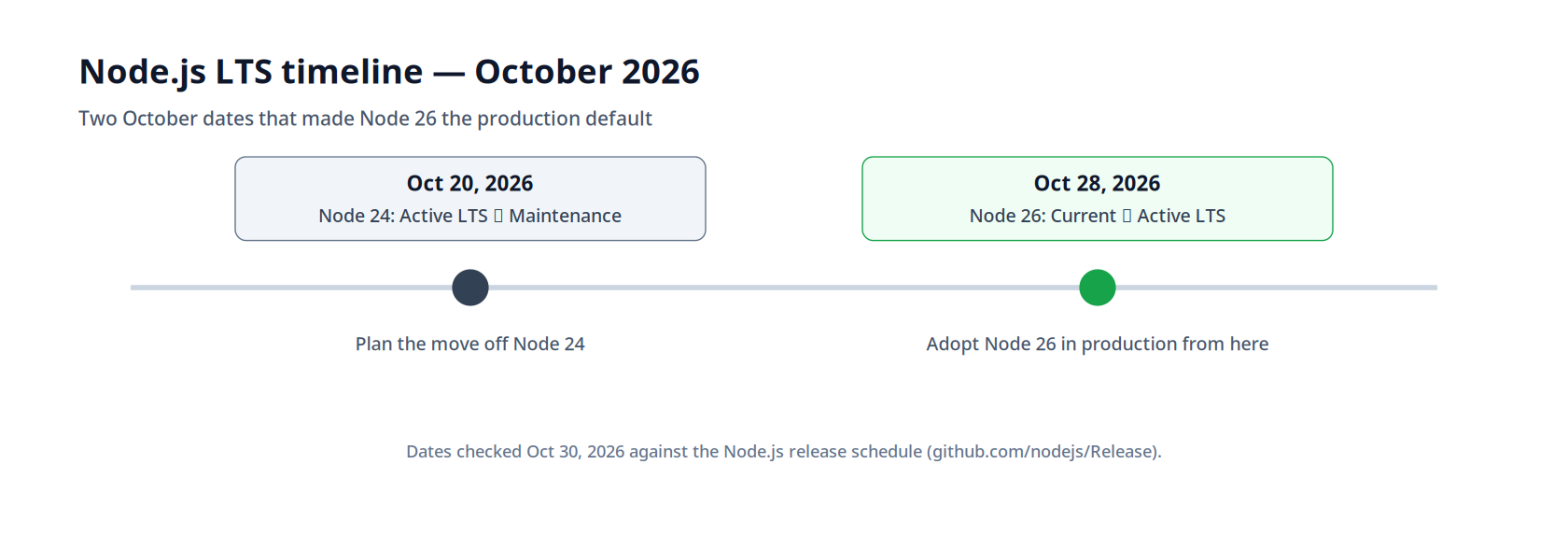
One status note before anything else, because getting this wrong is easy. Node 26 entered Active LTS on October 28, 2026, days after Node 24 stepped down into Maintenance on October 20. If your policy is to run LTS in production, as many teams do by default, then 26 is now the release that policy points at. Nothing about that makes it a rush job: the upgrade is worth doing deliberately, with the removals list below read first.
Temporal is just there now
Every Node developer has a date bug in their past. The classic version looks harmless: an invoice run computes a payment date by adding a month to January 31, and JavaScript cheerfully rolls the result into March. The code has no error in it, by the standards of the Date object. The arithmetic is the bug. Date mutates the object you are holding, months are zero indexed for reasons lost to history, and overflow rolls forward silently instead of telling you the date you asked for does not exist.
Temporal is the replacement the language has been building for years, and in Node 26 it is enabled by default. No flag. No package. You write Temporal and it is there.
Here is the same calculation, both ways. First, the version most codebases still carry:
// The Date way: mutation and silent overflow
const start = new Date(2026, 0, 31); // January 31, 2026 (month is 0-indexed)
start.setMonth(start.getMonth() + 1);
console.log(start); // March 3, 2026. February 31 does not exist, so it rolled over.
Nothing threw. Nothing warned. Read it as a hypothetical invoice run, because that is all it is: the computed due date comes out as March 3 instead of February 28, the payment goes out three days late, and the code review that approved the change saw arithmetic that looked correct.
Now the Temporal version:
// The Temporal way: immutable, and the calendar is honest
const start = Temporal.PlainDate.from({ year: 2026, month: 1, day: 31 });
const due = start.add({ months: 1 });
console.log(due.toString()); // 2026-02-28. Clamped to the last real day of February.
console.log(start.toString()); // 2026-01-31. The original never moved.
Three differences matter more than the syntax. First, months are numbered the way humans number them, so January is 1. Second, add returns a new value instead of mutating the one you passed around, which means a date handed to three functions stays the date all three of them saw. Third, when the target date does not exist, Temporal clamps to a real day of the month you asked for instead of drifting into the next one. February has no 31st, and now your runtime agrees with you about that.
That third difference has a knob on it, and the knob matters. Clamping is what add does by default, through an overflow option set to "constrain". Pass "reject" instead and the same call throws a RangeError rather than quietly moving the date. For due dates, reject is often the honest choice: a payment that cannot be scheduled should fail loudly in a test, not drift by three days in production.
const start = Temporal.PlainDate.from({ year: 2026, month: 1, day: 31 });
console.log(start.add({ months: 1 }).toString()); // 2026-02-28 (overflow: "constrain", the default)

const leap = Temporal.PlainDate.from({ year: 2028, month: 1, day: 31 });
console.log(leap.add({ months: 1 }).toString()); // 2028-02-29. 2028 is a leap year.

start.add({ months: 1 }, { overflow: "reject" }); // RangeError. February has no 31st, and the throw ends the script, so this line goes last.
The deeper shift is in how you review date code from now on. With Date, reviewing meant hunting for mutation and overflow by eye, because the type told you nothing about what a value represented. Temporal splits the concept into honest pieces. A PlainDate is a calendar date with no time and no time zone, which is the right shape for due dates, birthdays, and billing cycles. A ZonedDateTime is a moment pinned to a place, which is the right shape for an appointment. A duration is its own value you can add, subtract, and compare. When a function declares it takes a PlainDate, half the review questions answer themselves.
Start small. The next piece of date arithmetic you touch, a trial period, a renewal date, a report window, write it in Temporal and leave the rest of the file alone. The two systems coexist fine, and the conversion points are explicit:
const today = Temporal.Now.plainDateISO(); // today, in the system's time zone
const reviewDate = today.add({ days: 14 }); // two weeks out, still a PlainDate
const label = reviewDate.toLocaleString("en-CA", { dateStyle: "medium" });
TypeScript with no build step: already here, still worth using
Start with the correction, because this feature collects false credit. Type stripping is not a Node 26 feature. It landed behind a flag in 22.6, was switched on by default in 22.18 and 23.6, dropped its experimental warning in 24.3, and was declared stable in 24.12 and 25.2. If you are running a current Node 24, the script below already runs on your machine today, unchanged. What 26 actually does to this feature is smaller and stranger: it removes --experimental-transform-types, the old flag that unlocked the full transformation mode. From 26 on, erasable-only stripping is the only built-in mode there is, and there is no flag left that turns Node into a TypeScript compiler.
Why does it still earn a section in a post about moving to 26? Because an upgrade is when teams re-audit what their scripts actually need, and a stable, default-on stripper changes that audit. The behaviour, stated plainly: out of the box, Node executes TypeScript files that contain only erasable syntax. Type annotations, interfaces, and type aliases are stripped by replacing them with whitespace, and the remaining JavaScript runs. There is no type checking, tsconfig.json is ignored, and if you want the old behaviour back, --no-strip-types turns the feature off.
That set of limits is not a weakness to apologise for. It is the honest scope of the feature, and inside that scope it is genuinely useful:
// scripts/seed-check.ts, run it with: node scripts/seed-check.ts
interface SeedUser {
  email: string;
  role: "admin" | "member";
}

const pending: SeedUser[] = [
  { email: "[email protected]", role: "admin" },
  { email: "[email protected]", role: "member" },
];

for (const user of pending) {
  console.log(`${user.role}: ${user.email}`);
}
Every type in that file is erasable. The interface describes a shape and then disappears. The annotation on pending disappears. What reaches the engine is plain JavaScript, which is why it runs with no compiler, no loader, and no build folder for a script that will be executed a dozen times and then deleted.
The boundary is just as concrete. Syntax that needs the compiler to generate code is not erasable, and Node will not run it in this mode. An enum is the clearest case, because it asks the compiler to invent a runtime object that was never written in the file:
// None of this survives type stripping: the enum creates runtime code
enum Role {
  Admin = "admin",
  Member = "member",
}
A constructor parameter property fails for the same reason. It asks the compiler to invent an assignment, this.db = db, that appears nowhere in the source:
interface Database {
  query(sql: string): Promise<unknown[]>;
}

class Service {
  constructor(private readonly db: Database) {} // parameter property
}
Enums, namespaces that contain runtime code, and constructor parameter properties all ask the compiler to invent JavaScript that was never written in the file. A stripper that only erases cannot invent, so those constructs stay behind the build step where they belong. The official docs point at TypeScript 5.8 or newer, with settings such as erasableSyntaxOnly, if you want your editor and your runtime agreeing on exactly where that line sits.
Hold the scope firmly. This is not type checking, and a file that runs is not a file that was checked. Running the seed script proves the syntax strips cleanly; it proves nothing about the types, and npx tsc --noEmit over the same files is the step that proves those. Your services, your packages, anything with a real tsconfig contract, still belong to your normal toolchain. What this changes in practice is the small end of the world: the one-off script, the seed file, the migration helper, the diagnostic you write at 11 PM. Those no longer need a build ceremony before they are allowed to be TypeScript.
Two small language wins from V8 14.6
Node 26 updates the engine to V8 14.6, and two of the additions it brings are the kind that quietly delete code you have written a hundred times.
The first is upsert for maps. Map and WeakMap gain getOrInsert and getOrInsertComputed, which collapse the most repeated three-step in JavaScript, check, fetch or create, store, into a single call:
// Before: the has / get / set three-step, every counting loop ever written
const words = ["invoice", "payment", "invoice", "refund", "payment", "invoice"];
const counts = new Map();
for (const word of words) {
  if (!counts.has(word)) {
    counts.set(word, 0);
  }
  counts.set(word, counts.get(word) + 1);
}
console.log(counts); // Map(3) { 'invoice' => 3, 'payment' => 2, 'refund' => 1 }
// With getOrInsert: one lookup, one obvious default
const words = ["invoice", "payment", "invoice", "refund", "payment", "invoice"];
const counts = new Map();
for (const word of words) {
  counts.set(word, counts.getOrInsert(word, 0) + 1);
}
console.log(counts); // Map(3) { 'invoice' => 3, 'payment' => 2, 'refund' => 1 }
The computed variant covers the case where the default is expensive and should only be built when the key is truly missing. The callback receives the key, runs once, and only when an insert actually happens:
function buildHandlerFor(name) {
  console.log(`building handler for ${name}`);
  return (event) => ({ handledBy: name, event });
}

const handlers = new Map();
const eventName = "invoice.paid";
const first = handlers.getOrInsertComputed(eventName, (key) => buildHandlerFor(key));
const second = handlers.getOrInsertComputed(eventName, (key) => buildHandlerFor(key));
console.log(first === second); // true. The factory printed once: it ran only for the miss.
The second addition is Iterator.concat(), which chains synchronous iterables into one lazy sequence. Lazy is the word that earns its place here. Nothing is read until something pulls from the combined iterator, so concatenating a small in-memory list with a long paged source does not mean materialising the long source. One boundary to state plainly: the sources must be synchronous iterables. An async stream does not drop into concat unchanged; it belongs to the async iterator helpers instead.
This demo declares everything it uses, and the generator logs each value at the moment it is produced, so you can watch the laziness happen:
function* pagedResults(pages) {
  for (const page of pages) {
    for (const item of page) {
      console.log(`pulled ${item}`);
      yield item;
    }
  }
}

const localItems = ["a1", "a2"];
const remoteItems = pagedResults([["b1", "b2"], ["b3", "b4"]]);
const fallbackItems = ["c1"];

const feed = Iterator.concat(localItems, remoteItems, fallbackItems);
for (const item of feed.take(3)) {
  console.log(`rendered ${item}`);
}
// Output order: rendered a1, rendered a2, pulled b1, rendered b1. Then it stops.
// b2, b3, b4, and the entire fallback list were never produced.
Spread the same sources into an array, [...localItems, ...remoteItems], and the generator drains completely before the first item renders. concat with take is the difference between producing three values and producing all of them.
Neither addition will headline a release. Both will be in your code within a month of upgrading, and neither will ever be mentioned again. That is what a mature runtime maturing looks like.
The upgrade checklist nobody reads until it breaks
Features get the blog posts. Removals get the incident reports. Node 26 carries a short list of changes that only matter if they are true of your codebase, and the whole list can be checked in an afternoon, before the upgrade, while it is still boring.
| Check | What changed in 26 | What to do |
|---|---|---|
| Native addons | NODE_MODULE_VERSION rises to 147 |
Check native dependencies for Node 26 support. Addons tied to the version-specific V8 or Node C++ ABI need a rebuild or an updated prebuild before they will load. Addons built on Node-API are the exception: Node-API is ABI stable by design, so they are built to keep running across majors without recompilation. Test them anyway. |
| HTTP servers | http.Server.prototype.writeHeader() is removed |
Search for writeHeader and switch those calls to writeHead(). |
| Streams internals | The legacy internal _stream_* modules are removed |
If anything imports them, it was relying on internals. Replace with the public streams API. |
| Crypto, short GCM tags | DEP0182 is end-of-life: GCM decryption no longer accepts a short authentication tag on its own | Grep for createDecipheriv used with GCM ciphers. Anywhere the authentication tag is shorter than the default 16 bytes, set the authTagLength option explicitly to the tag's real length, or decryption fails under 26. |
| Module hooks | module.register() is runtime deprecated (DEP0205) |
Move registrations to module.registerHooks() and add no new register() calls. Review the behaviour change as you swap: registerHooks() runs hooks synchronously on the main thread, while register() ran them in a separate worker thread. |
| HTTP behaviour | Bundled fetch now runs on Undici 8.0.2 |
Re-run your HTTP integration tests. Same API, new engine room. |
Read the table as a search list, not a reading list. Every row is a term you can grep for, a dependency you can list, or a test suite you can run. The teams that get hurt by a Node major are rarely hurt by the change itself. They are hurt by meeting the change for the first time in production, at full traffic, with the rollback conversation happening live.
fetch changed underneath you, politely
The last item on that checklist deserves its own paragraph, because it is the one most likely to be misread as a performance promise. The fetch you call in Node is provided by Undici, and in Node 26 the bundled version moves to Undici 8.0.2. Your code does not change. Your headers, your streaming, your error shapes at the edges of real networks, all of that is now being executed by a newer client than the one your tests last ran against.
So the correct response is not excitement and it is not fear. It is a test run. Point your integration suite, the one that talks to real services or faithful stand-ins, at a Node 26 build and watch it. If it passes, you have earned the upgrade cheaply. If something at the margins moves, you found it in a test run, which is the cheapest place any behaviour change will ever be found.
Read the removals first
There is a pattern across Node's recent majors, and 26 states it as plainly as any of them. The features in this release are generous but optional. Temporal waits until your next date calculation. Type stripping waits until your next throwaway script. The map helpers wait until your next counting loop. You adopt each one at the speed of your own codebase, and nothing about them is urgent.
The removals run on the opposite clock. They are already true the moment the new runtime starts, whether you read about them or not. So read the release the way this post tried to. Features second, for pleasure and for planning. Removals first, with a search box open and an afternoon set aside. Node 26 shipped quietly powerful stuff. The teams who get the power without the incident will be the ones who treated the quiet part as the important part.
Sources
- Node.js 26.0.0 release announcement: https://nodejs.org/en/blog/release/v26.0.0
- TypeScript type stripping, including the version history table: https://nodejs.org/api/typescript.html
- Node-API and ABI stability: https://nodejs.org/api/n-api.html
- Deprecations, including DEP0182 (short GCM tags) and DEP0193 (
_stream_*modules): https://nodejs.org/api/deprecations.html - Module hooks,
module.register()andmodule.registerHooks(): https://nodejs.org/api/module.html - Temporal
PlainDate.add()and the overflow option: https://developer.mozilla.org/en-US/docs/Web/JavaScript/Reference/Global_Objects/Temporal/PlainDate/add - Node.js release schedule (LTS dates): https://github.com/nodejs/Release